

Trust me, it’s an Easy Fix💲
10 Free Downloads Await! Sign up for Creative Fabrica’s All Access Free Trial and enjoy 10 free downloads to kickstart your creative projects.
Not making enough money with your laser business? That was me, until I figured out this one silly simple thing. Ya, it’s your fault, but luckily, you’ve got me in your corner, so let’s fix this together and make you some tasty profits! 💸
➕ Subscribe to my YouTube Channel HERE
The Psychology of Pricing
You ever been to a movie theater lately? Theater food is notorious for some ridiculous reasons. One being the difference in price between it’s medium and large popcorns. You’re a reasonable person, so you order a medium popcorn and the server says, “For only 50 cents more you can get a large. Do you want to size up?”
What a deal, you think. But, why did you want a medium to begin with?
The small is pretty small… for only $2 more, you can get a medium, which is reasonable enough… compared to the small. It’s just too small. The large is nearly twice the size of the medium, and for only 50 cents more, it almost feels like you’re ripping them off. Might as well go for the large, even if you don’t finish it.
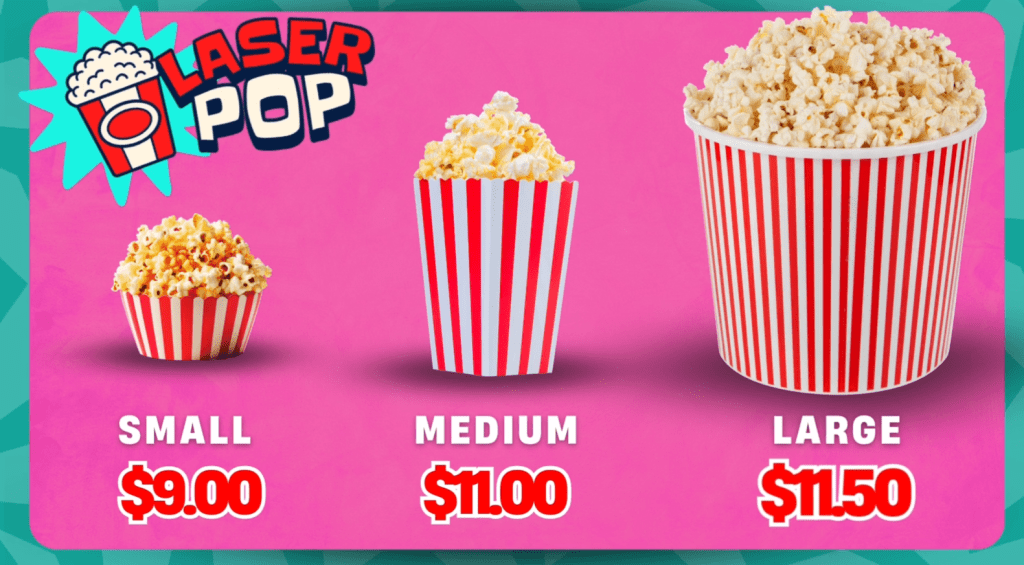
Well, the jokes on you sugar plum. The popcorn only cost them pennies. The amount of labor paid to the employee that got your popcorn is the same amount no matter if you got a small or a large. So let’s assume the total cost of the popcorn, adding in the labor and need to pay their business bills, it will cost the theater a couple bucks. But you covered that tenfold, plus the 50 cent upcharge. Let’s not even go over the pure profit of carbonated sugar water.
But, do you even feel duped? Do you think they tricked you? Are you not happy with your purchase of $12 popcorn?
Do you get the generic brands at the grocery store? Do you splurge the 50 cents to a dollar when the “nice” brand is on sale?
There are a lot of pricing methods that you know about, like the “for just 50 cents more” sort of thing, or $3 or $2.99. I just want you to think about how you plan to range your prices. Surely, you have lower cost, mid range and high ticket items. And, if you don’t it’s time to look into that.
The Necessary Mind-Shift of Pricing Handmade Products
There is one very serious mind-shift that is needed to transition you from a crafter to an entrepreneur. To put it simply, it’s the difference between covering your cost of the project and paying your real-life people bills.
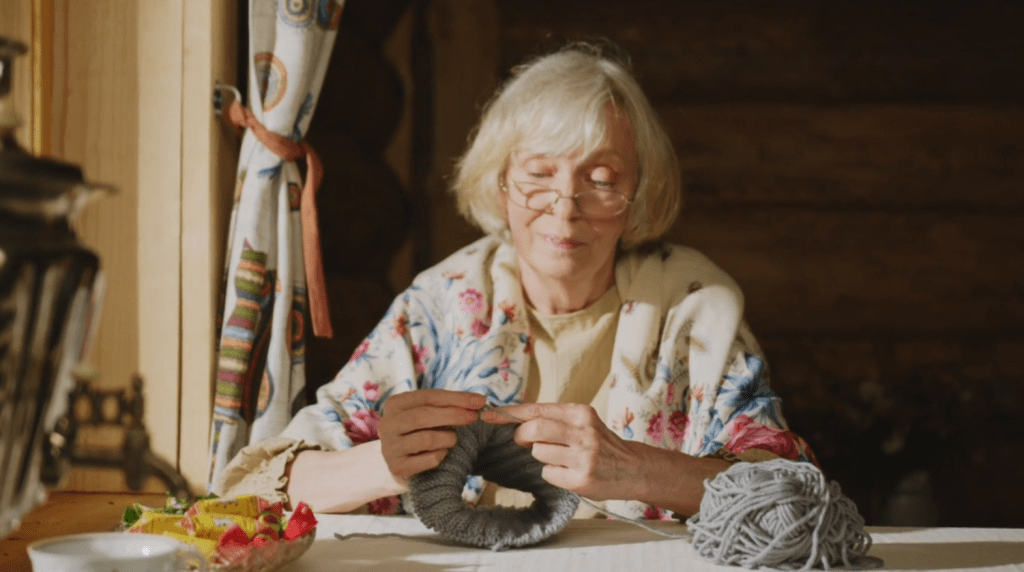
Over last Christmas, I went to my local rec center for a craft show put on to support the retiree activities they sponsor. So, the place was packed with grandmas. Grandmas are the best people on the planet, but the one thing they aren’t ~ is trying to make a fulltime living off their crochet towel holders.
I got this towel, towel holder, and these trivet/potholder thingies ALL for $6. Assuming it only cost her $2 for materials and giving her a $4 profit, if she wanted to make $40k a year off of this, she’d only need to sell 10,000 of these! That’s just over 192 towel sets a week. I think her hands would fall off. No more high fives from grandma!
If you’re thinking, “Well, no one would buy that for more.” You might be right, and that’s when you need to take a look at your products and maybe add some mid and higher priced items. But, that’s also a good question because WHO even IS your customer?
Value Lies in the Eye of the Beholder
I’m pretty cheap, personally. I clip coupons, I wait for sales, I go thrifting. But, I’ll throw my money at something that means something to me. My son and I get fancy coffees or boba teas on Fridays. It’s our special little drink time, and even though I could make our own drinks, the outing plus fancy flavors and all that makes an $8 cup of coffee worth it.
Some people are cheap and clip coupons like me but need a $600 Coach purse. Some people are super rich, or wish they were, and would buy this trash bag dress for more than most people make in a year. It’s real. This is real.
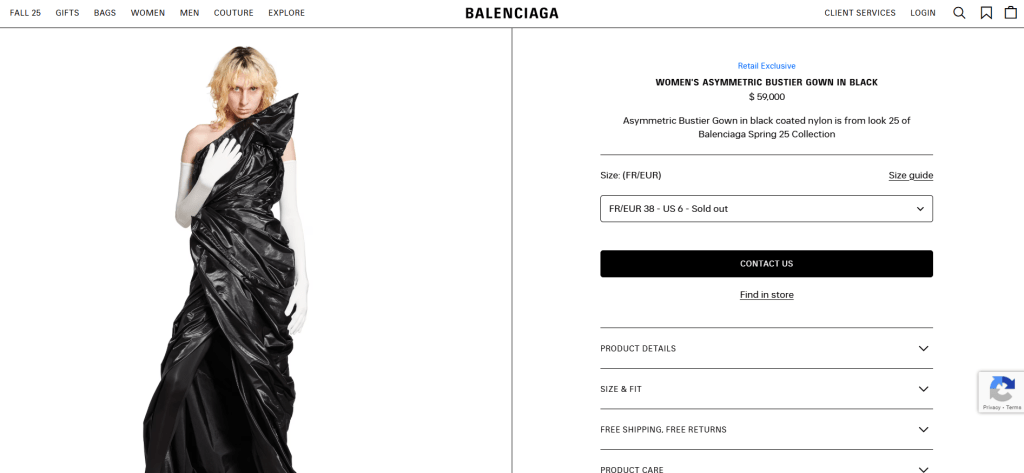
That’s why it’s important to know who your customer is. How much money do they make? What’s a reasonable cost to them? Do they have expendable funds or are they living paycheck to paycheck?
I mostly sell weird jewelry and these decorative signs. My price range is between $10 and $100. The majority of my wares are priced between $15 and $40 because I sell the most in the middle cost range. I’ve had people scoff at my prices and even more people say they are reasonable, especially as they are handing me their money.
A lot of the perceived value of an item comes with the connection a person has with the subject of the item. If you sell horse themed things, your items are going to mean a whole lot more to people who like horses. If you sell gamer-centric things, it will connect more with gamers, and so on.
That’s why when you are learning about business, they always talk about niches. Sure, you can make generic cute earrings to appeal to people who like cute-jewelry. But what about cute jewelry lovers who are also cat people. Or horse people, or gamers. The value for them is going to increase, which means your ability to charge more increases.
So, how do we calculate all this?
How to Calculate Product Prices So You Can Make a Living
The first thing you need to think about, before we whip out a calculator is this – What skill or specialty makes your products special?
If you’re reading this, there’s a good chance that you fiddle around with lasers. Not everyone can just go laser a thing. They can’t just engrave a tumbler or cut out a custom sign.
I recently paid $350 for a guy to come out and replace an outdoor spigot. I know the spigot only cost like $20. He had to solder on a little new piece of pipe and it only took him 45 minutes. Surely, he’s not getting paid $300 an hour, so what the hell cost so much? His expertise. If I was capable of soldering and plumbing, I would have. But I can’t, so I pay up for someone else’s skill.
If I were to get a painted portrait of my cat, should the painter just consider the cost of the paint and canvas? Well, the canvas was only $8 and the paints… so, let’s say $50? Or do we calculate the 5 hours it took to paint, at $20 an hour for labor, so $150? Or do we add in the technique classes, 25 years of painting experience, and absolute gifted skill? How do you even calculate that?
Ok! Here’s the math we’ve all been waiting for as well as that super simple thing I mentioned at the start.
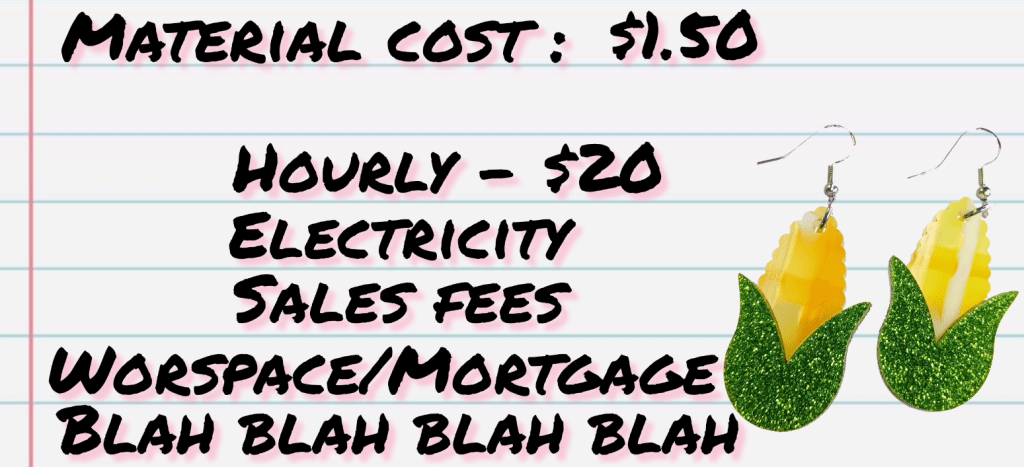
Let’s use these Corn Cob Earrings as an example. The breakdown of the cost to produce, such as the acrylic and packaging is about $1.50.
The complicated way to add to this would include an hourly breakdown, like $20 an hour (which is about $40,000 a year). Then I can calculate my cost for electricity and average online sales fees, and the cost of my workspace compared to my mortgage and blah blah blah.
OR!
Ask yourself how much you want to make a year. Let’s say $40,000. How many corn earrings could you make in a week? Obviously, you’d probably be making other designs, but let’s focus on corn. I bet I could make 10 a day, that’s 50 a week.
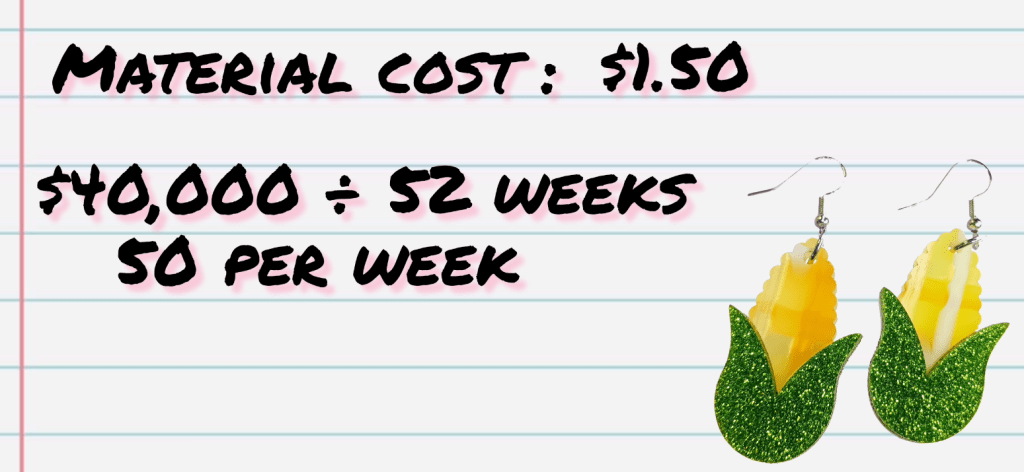
$40,000 a year translates to about $770 a week. Let’s divide that by 50 corn earrings, we get $15.40. Adding on the $1.50 for materials, I could sell these for $16.90 or $17. Thinking about what we learned with psychological pricing, I sell these at shows for $18.

BUT! These cost me 50 cents and I sell them for $12.

These cost me maybe $2 and I sell them for $28!

So, which formula do we choose?? None. There is no such thing as the Ultimate Product Pricing Calculator. That’s the super simple thing. The only wrong way to price your products is too low.
You have talent and you have skill and you deserve to make a decent amount of money. Don’t price your things too low, it will diminish the value of your talent. If you price things too high, allow customers to try and haggle you. If you keep getting the same price from multiple people, that’s a good sign as to what range your customers are looking for.
Make connections between your products and your customers and anytime you find your winning product, add a couple bucks to it. Before you know it, you could be making twice as much as you were initially hoping for.

Never give up, never surrender.
And, if you’d like to see what it’s been like with my laser business for the 10 years, and how much I’ve made, then check THIS OUT.
Happy Crafting!
Sign up for Creative Fabrica’s All Access Free Trial and enjoy 10 free downloads to kickstart your creative projects. Plus they’re having a Subscription Sale, so check it out!
 Learn with Laser Lady
Leave a comment